Understanding the Payment Life Cycle
Last updated: June 10, 2026
Overview
The payroll payment life cycle outlines the end-to-end process from payroll setup through employee payment and post-payroll adjustments.
Understanding payroll submission deadlines, funding requirements, and available options when deadlines are missed helps ensure employees are paid on time and payroll obligations remain compliant.
Payroll processing follows a structured timeline that includes payroll submission, funding, employee payment, and any required corrections or adjustments after payroll has been processed.
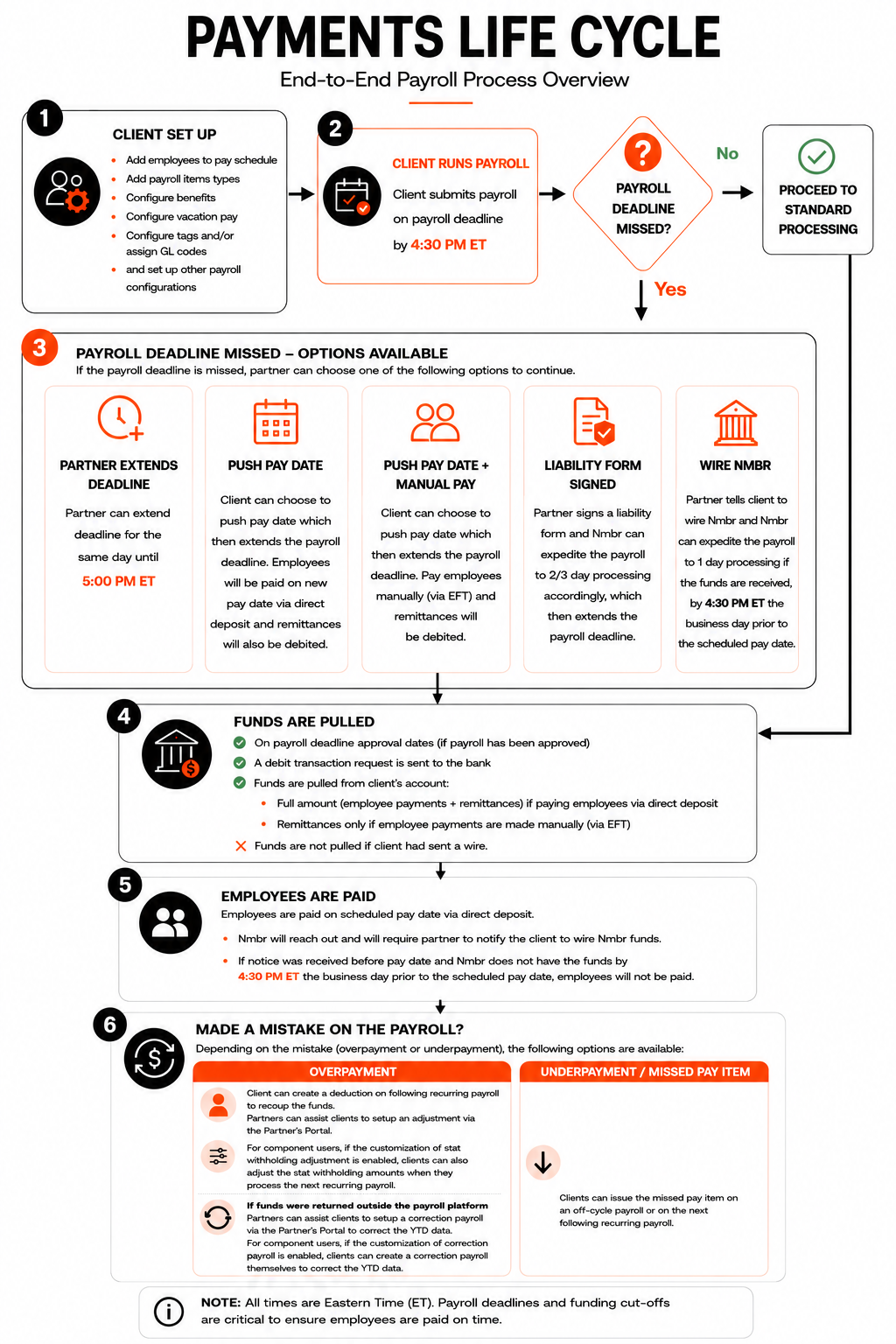
Standard Payroll Submission Process
Ensure all employee information, pay schedules, earnings, deductions, benefits, and payroll configurations have been completed.
Review payroll details for accuracy.
Submit payroll by 4:30 PM ET on the scheduled payroll due date.
Employees will be paid on schedule pay date.
If the Payroll Deadline Is Missed
Depending on the circumstances, one of the following options may be available:
Option 1: Extend Payroll Deadline
Where available, the payroll deadline may be extended until 5:00 PM ET on the same day.
Refer to instructions in 📄 Deadline Extension Tool
Option 2: Select a New Pay Date
If a delay in employee payment is acceptable:
Update the pay date to a future date.
Submit payroll using the revised pay date.
Payroll processing timelines will adjust accordingly.
Refer to instructions in📄 What should I do if I missed the payroll deadline?
Option 3: Process Manual Employee Payments
If employees must be paid on the originally scheduled pay date:
Process employee payments outside the platform using EFT or cheque.
Complete payroll processing within the platform after manual payments have been issued.
Ensure payroll records accurately reflect the payments made.
Option 4: Liability Form Processing
In specific situations, a signed liability form may allow expedited payroll processing timelines.
Important:
The liability form must be signed by an individual with authorized signing authority for the employer.
The signer must have the authority to legally bind the organization and accept responsibility for the associated payroll processing risks.
Once the signed liability form has been received and approved, expedited processing may be available based on operational and banking requirements.
Availability, approval criteria, and processing timelines may vary depending on the circumstances.
This option may extend the payroll deadline by allowing payroll to be processed under an approved expedited processing arrangement.
Option 5: Wire Funds
Where available, funds may be wired to support expedited payroll processing.
To qualify for expedited processing:
Wire instructions must be followed as provided.
Funds must typically be received by 4:30 PM ET on the business day prior to the scheduled pay date.
Processing availability is subject to banking and operational requirements.
Key Details or Requirements
Situation | Outcome |
|---|---|
Payroll submitted by 4:30 PM ET | Direct deposit processing occurs as scheduled |
Payroll deadline missed | Manual payments, pay date changes, or other options may be required |
Deadline falls on a statutory holiday | Deadline automatically moves to the previous business day/ business after depending on the business setting |
Employees paid manually outside the platform | Payroll must still be processed in the platform |
No employee payments required | Payroll must still be processed with zeroed pay items where applicable |
Reminder: Statutory Holiday Deadline Adjustments
If a payroll submission or approval deadline falls on a statutory holiday, the deadline automatically moves dependant on the business setting.
This adjustment ensures sufficient banking and direct deposit processing time remains available.
Important Considerations
All payroll deadlines and funding cut-off times are based on Eastern Time (ET).
Payroll must be submitted by 4:30 PM ET on the scheduled payroll due date unless an approved extension applies.
Direct deposit processing timelines depend on banking availability and processing windows.
Missing a payroll deadline may result in delayed employee payments.
Manual employee payments do not eliminate the requirement to process payroll within the platform.
Payroll continuity must be maintained before future pay periods can be processed.
Employers remain responsible for applicable CRA remittance obligations, including reporting nil remittances.
If payroll has been approved and employees are being paid through direct deposit, funds are typically withdrawn from the employer account based on payroll processing timelines.
When employees are paid manually outside the platform, remittance amounts may still be collected and processed through standard payroll workflows.
Summary
The payroll payment life cycle begins with payroll setup and payroll submission, continues through funding and employee payment, and concludes with any required payroll corrections or adjustments.
Payroll submitted before the applicable deadline will process through standard direct deposit timelines. If a deadline is missed, available options may include extending the deadline, selecting a new pay date, issuing manual employee payments, signing a liability form, or wiring funds where available.
Regardless of whether employees are paid manually or no employee payments are required for a pay period, payroll processing must still be completed within the platform to maintain payroll continuity, support remittance obligations, and ensure accurate payroll records.
Disclaimer
This article explains product functionality and is provided for general informational purposes only. It should not be relied upon as tax, legal, financial, benefits, or HR advice. Because regulations vary by jurisdiction and evolve over time, consult a qualified professional for guidance related to your organization or situation